
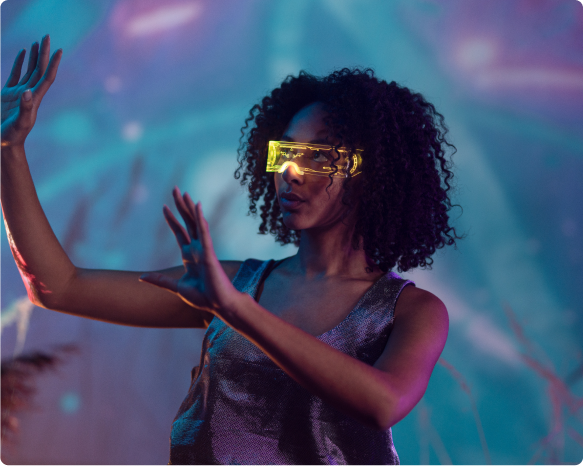


The metaverse is an idea that has gained popularity in recent years and refers to a 3D virtual universe in which users can interact with a digitized world in real time. Although the concept of the metaverse has been popularized by Mark Zuckerberg and promoted as a solution to many real-world problems, there are arguments that question its viability in the short term.
First, the metaverse relies on advanced technologies that are not yet fully developed. Creating a real-time 3D virtual world requires extremely high data processing and storage capacity. While technology has advanced significantly in recent decades, there are still several challenges that must be overcome to make a realistic metaverse possible.
We are not only talking about the ability to interoperate all existing virtual worlds, but also technologies, economies, societies, among others, even reaching a biological level, which has to do with our senses.
How do the senses coexist in a 3D environment?
We know that at a graphic level, in technology, we have been able to advance quite quickly, generating increasingly realistic virtual worlds; however, the adoption of devices that allow us to immerse ourselves in a 3D environment has not yet become as widespread as the companies that manufacture them expect.
Technological devices such as VR headsets, among others, are quite well known in the field of video games, but they are not yet adopted by most players and video game development companies, as they present challenges that go beyond the technology itself.
Currently, entering existing virtual worlds such as social networks or video games requires quick and easy interaction on a 2D screen; however, achieving the immersion that the metaverse aims for in a real-time virtual environment is more complex, not only in terms of how cumbersome it might be to equip oneself with some suit or device that allows us to enter this 3D environment.
For this purpose, there are some popular and commercially available VR headsets. These headsets still cause health problems with prolonged use, such as dizziness and/or headaches, because they primarily try to trick our senses into believing we are moving when the brain knows we are still, or into hearing something from a certain location without having to move our head to orient our ears, which isn't entirely convincing.
What are the limitations of our senses?
Our bodies haven't had enough time in the last few hundred years to adapt to many technological changes, but in this case, we try to make our brains believe that something virtual is real, and they can't differentiate it, so they assume that this lack of realism is a problem our senses are having with the environment.
Apart from these popular VR headsets, which bombard our eyes with images and our ears with sounds, little progress has been made in haptic adapters, which would allow us to feel that virtual world through touch.
There are some gloves and backpacks that generate vibrations that try to emulate the sensation of something touching or hitting us, but they are far from feeling real, so forget about feeling a breeze on our skin and even less the sensation of wet skin.
Nor could we speak of emulating sensations in a virtual environment using our sense of smell. While there are some experiments with devices that combine different chemicals to produce simulated aromas, these don't generate changes in intensity or aroma depending on where we point our nose. Therefore, they remain experiments in very early stages. Similarly, there are no significant advances with taste, and that's why we couldn't speak of a feeling of satiety from eating something virtual.
The closest thing to this might come with some brain implant technology, but we know that these are also still very limited and restricted, not to mention the risks that haven't even been discussed yet.
Today, isolated virtual worlds exist in video games, social networks, and other virtual laboratories, and in the short term, the metaverse could be seen as the integration of all these systems. However, it can hardly be seen as a virtual world parallel to our own, where we spend most of our time in the short term, since fortunately, the real world is still more interesting than the virtual world. Therefore, the metaverse, as of today, could only be considered a good idea for a certainly distant future.