
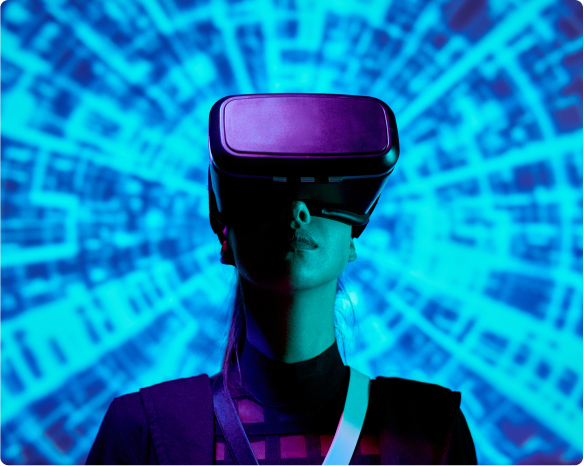


Today, the rapid pace of technological advancement is quite evident, as is the need for markets, businesses, shops, and individuals to adapt to these often abrupt technological changes. Failing to make the necessary adjustments in time means falling far behind the competition and customers. For this reason, the term "innovation" is gaining significant importance. It has become a necessary process for companies and various organizations seeking to take an idea and implement it as accurately and quickly as possible.
This gives rise to entrepreneurs who take technological advancements like Augmented Reality and Virtual Reality and transform them into commercial innovations. These new ideas create companies and services that tend to develop rapidly, and consumers demand the new products and services.
To cite a few examples of the growth of these technologies we can mention:
• In 2012, Facebook generated a lot of buzz in the market when it spent $2 billion to acquire the VR company Oculus Rift. Ref 1
• In 2015, Venture Beat announced that this market was growing by leaps and bounds; that year, the number of new competitors went from 10 per year to 234 in 2015 alone.Ref 2
• In 2017, Samsung sold 3.65 million virtual reality devices. This attracted so much attention that it prompted major manufacturers, from Apple to Google, including Cisco and Microsoft, to investigate the topic.Ref 3
• The number of users of these technologies continues to grow. The company eMarketer reported that in 2017 there were 22 million monthly users, which increased to 25 million by 2018.Ref 4
• Different estimates tell us that the augmented reality and virtual reality market will be around $35 million and it will be very difficult to find a market segment that is not affected.
Augmented Reality (AR) and Virtual Reality (VR): definition and practical uses
What is augmented reality? We can all surely remember holograms in movies like Star Wars. If someone were to develop something similar today, we would consider that augmented reality. Now imagine watching YouTube videos that way.
Augmented reality has been around for quite some time; we just didn't have the necessary tools to fully utilize it (fortunately, we do now). AR has been gaining momentum for some time, especially in video games. Currently, it's possible to give it much more practical applications for various industries and society in general. In short, AR is a range of technologies that allow us to see the real world through a technological device with added graphical information.
What is virtual reality? Let's continue with movies, as they provide a very visual way to explain things. Among many films, The Matrix is the perfect example of virtual reality. Recall that the protagonist Neo enters, or is in, a system that takes him to a simulated reality world in which all humans once lived.
VR itself is a graphical representation that gives the sensation of its real existence; we can enter digitally constructed worlds that do not exist in physical space, but with the right devices we experience this world as if we were physically there; agile and simple.
Examples and practical applications
• Immediate Information: Providing real-time information to people so they can make decisions about traveling, browsing, working, or carrying out any type of personal activity
• Apple Glasses: Apple is developing its augmented reality glasses, which the company believes can replace the iPhone by bringing all the phone's main functions into the user's field of vision. This will allow users to see incoming notifications, get map directions, make/receive calls, and take photos directly from their face.
• Manufacturing: Visual aids for the production of goods and services. This will lead to better results, less waste of materials and time, and greater productivity.
• Inclusion: Empowering people with disabilities to manage their interactions and movements, giving them the opportunity to experience the world through speech, writing, or movement.
• Pokémon GO: This is the most famous example of AR today. It became popular in 2017 and reached 45 million active users. It consists of searching for and capturing different Pokémon characters throughout the city. By blending the virtual with the physical world, that is Augmented Reality.
• Google Glass: These devices allow you to display information from your mobile phone through your glasses, controlled by voice commands. Google Glass is just the first of many ways in which different devices, such as glasses, hearing aids, etc., can make senses like sight the primary means of connecting to the internet. It is expected that in the next 5 years, 10% of reading glasses will be connected to the internet.
• Driving scenarios: With AR, driving scenarios can be developed to increase road safety and give the driver warnings about potential risks and help prevent accidents.
• Biotechnology: Imagine a surgeon about to perform an operation, and with the support of AR, he can know in real time the patient's vital signs, medical history, details of supplies, etc.
• Tourism
• You can walk down an unfamiliar street and simultaneously view digital information about nearby restaurants, including their quality, reputation, menu, available tables, and prices. And while you walk, you can make a reservation and place your order before even arriving.
• Suppose you are visiting some historical site anywhere in the world and, with the use of an immersive experience device, you can experience what life was like right at the time when a certain civilization was at its peak.
• More senses:
• Currently, systems are beginning to delve deeper into many more senses than just sight. For example, the HEAR360 “omnibinatural” microphone system captures 360 degrees of audio, which means we could already have immersive audio.
• We can also talk about touch, because full-body suits, vests and gloves with sensory functionality are already on the market ref 5
• Raising awareness or changing behavior: At Stanford University, several VR experiments have been developed to provoke behavioral changes, including immersive first-person experiences that allow the user to feel or illustrate racism, sexism, and other forms of discrimination.
• Teaching:
• In different industries, AR simulations can help us learn much faster how to use different types of machinery and even what it feels like to pilot an airplane.
• In a school that has AR that allows students to explore both physical and virtual objects, they can virtually visit buildings or historical places, witness historical speeches, see an operation, etc.
• House sales: To be able to show potential buyers the immersive experience of walking through the place they want to buy, including the house, apartment, as well as the common areas, green spaces, etc.
• Entertainment: Can you imagine what this technology could mean for the entertainment industry? I'll leave that question open, so I invite you to leave your answer at any of our points of contact.
• To conclude: “At the end of the 19th century, it took four weeks to travel by wagon from Chicago to New York. A few decades later, trains shortened the distance to four days, and airplanes reduced it to four hours. But in just a few years, the Hyperloop will make that journey in less than an hour, and virtual reality and avatars have the potential to reduce it to zero.”
Quote taken from the book: The future is moving faster than you think
Other important points would be to mention things like instant translations, advertising, etc.
Risks associated with these technologies
However interesting and useful a technology may be, we cannot ignore the cybersecurity aspect. For this reason, I'm sharing a risk analysis to consider, aiming to support and guide its implementation. I'm not suggesting we stop using AR or VR; I'm suggesting we use them in the best way possible.
An example of risk could be the following:
Imagine that malicious software (virus, malware) causes someone using AR applications to see things that aren't really there, false information, or misleading directions. This could lead to serious accidents.
Another example is cyber espionage, which aims to steal information about the location, route, etc., of the person using the device.
Unreliable content: Just as is happening today with the spoofing of websites, applications, etc., hackers may also try to carry out these acts using AR and VR, replacing the user's environment with one of their own design.
Social engineering: It is very possible that cybercriminals will try to modify users' perception of reality through various strategies to get users to perform certain actions.
It's important to remember that any technology is a potential target for cybercriminals, so it's crucial to protect ourselves from these types of attacks.
For these systems to be secure from the outset, security must be included from the beginning in the application development lifecycle. This way, it will function as required by the user, but will also be protected with layers of prevention against attempted attacks or unwanted instructions.
References
3. https://www.statista.com/statistics/752110/global-vr-headset-sales-by-brand/
5. https://www.wsj.com/articles/virtual-reality-now-with-the-sense-of-touch-1522764377