



Three important digital platforms for disseminating science and data published the work done by our Director of Innovation, Ph.D.(c), Tomás Vera, and the Project Leader and Senior Data Scientist, Ph.D.(c) Alejandro Álvarez.
These are the research articles “What is the most important or influential element in a network?” and “Wandering walk of chimera states in a continuous medium”.
The first was developed collaboratively by Alejandro Álvarez, undergraduate student Nicolás Poza, PhD candidate Kilver Campos, and Tomás Verá, with the aim of presenting a method for locating the most important nodes in a network. Currently, this problem is generating widespread interest across scientific disciplines, particularly within Data Science, an interdisciplinary field that uses scientific methods, processes, algorithms, and systems to extract value from data.
“The article was published on the Medium platform, and the English version was also disseminated in Towards Data Science, one of the most important dissemination channels in the world of Engineering and Data Science.”
“Thanks to the internet, the word ‘influencer’ is all the rage, and we usually identify them by their likes or views. However, identifying an influencer on other types of networks isn’t so simple; no one likes cells for how they metabolize an enzyme. Nevertheless, academia has developed a set of strategies that allow us to identify the most important element(s) of a network, some being more efficient than others,” Vera explains.
As part of the study, he says that with the team, “we asked ourselves if it was possible to find a cheap and fast way to hunt influencers, and that's how we developed a strategy that uses random routes on the network, allowing us to hunt influencers in a cost-effective way! Now we have a new cost-effective mechanism to identify the most influential enzyme in cell metabolism, the most influential route in urban transport networks, or the route in a virtual store that generates the most sales.”
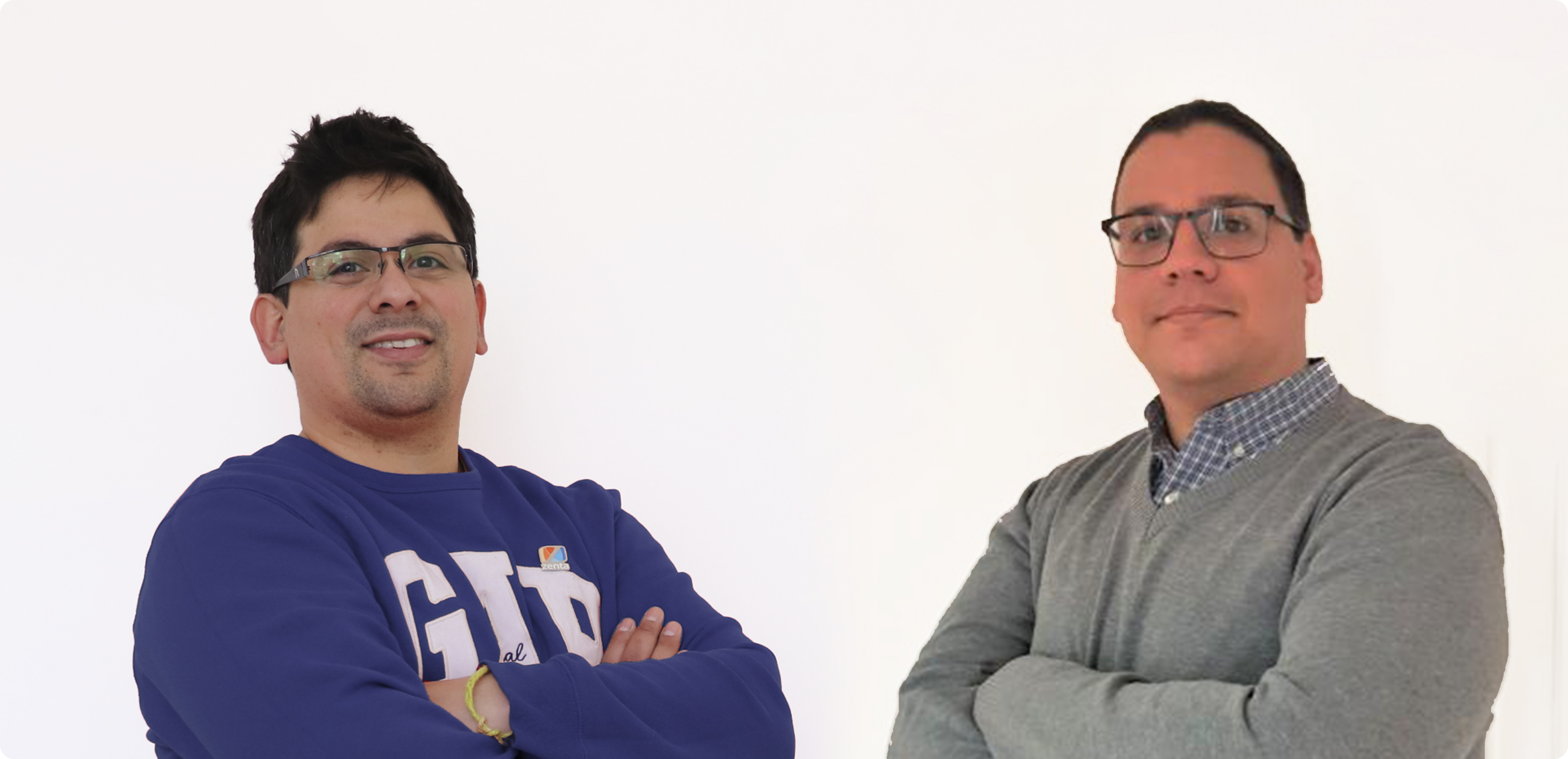
Tomás Vera - R&D Director and Alejandro Álvarez - Project Leader and Senior Data Scientist
“As for the second one, it was carried out by Alejandro Álvarez together with the University of Chile and the Millennium Institute for Research in Optics, and its dissemination was carried out in the interdisciplinary journal Chaos, Solitons and Fractals, one of the most prestigious in the discipline of Nonlinear Science.”
As our Project Leader explains, “nature and technological creations are full of patterns, and this paper attempts to understand and explain a type of movement seen in these patterns called “wandering.”
With the publication of these and other papers to come, at Zenta we hope to continue contributing to knowledge in the sciences, both in our country and internationally.