



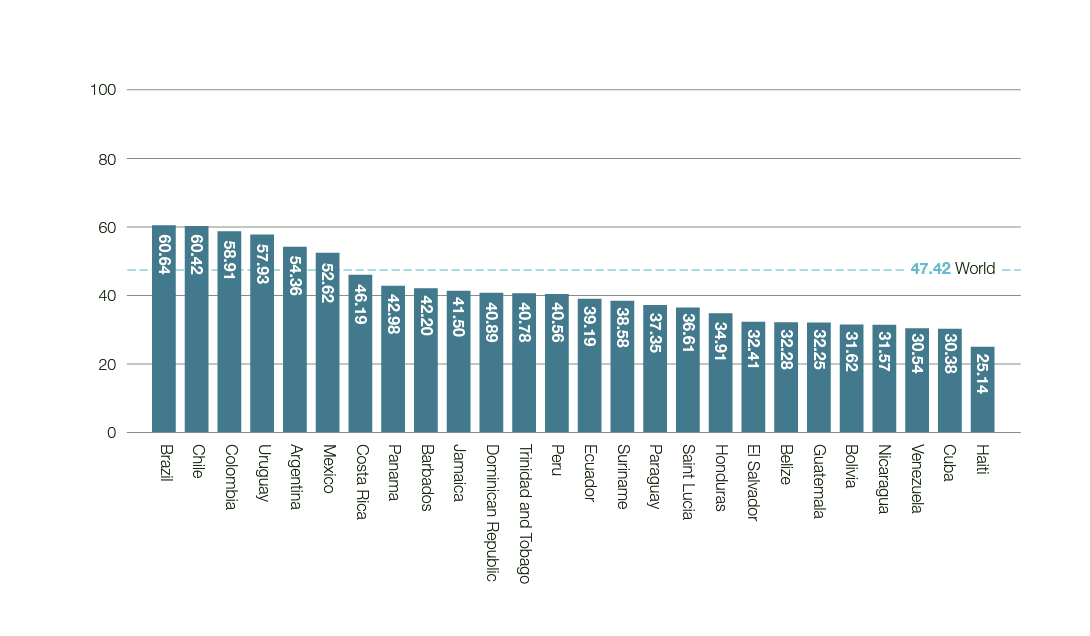
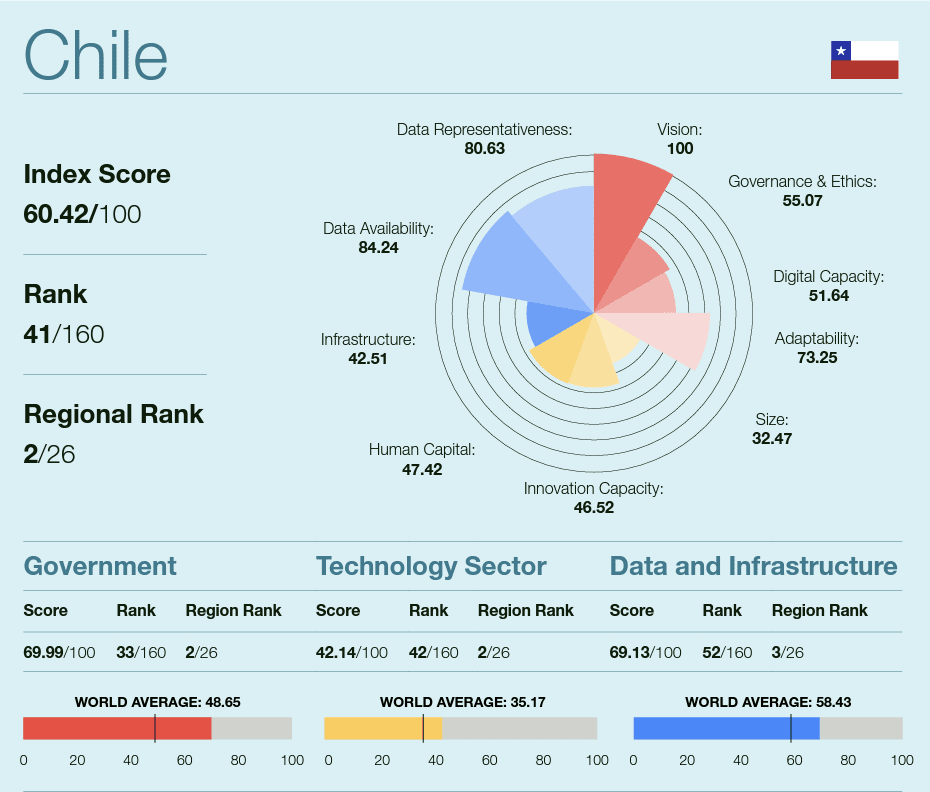
The term artificial intelligence (AI) formally emerged between the 1950s and 1960s; however, in recent years we have seen its enormous advances and benefits for society, such as, for example, DART An initiative that uses an AI algorithm to diagnose diabetic retinopathy, one of the leading causes of blindness in Chile, in a timely manner. AI also presents challenges from an ethical standpoint and in terms of the regulatory framework that may exist in each country. Some of these ethical challenges relate to a lack of transparency, invasion of privacy, or the presence of discriminatory biases in algorithms, such as those presented by [the relevant document/program/etc.]. DALL.E 2 (a tool that uses AI to generate images based on natural text). If we ask DALL.E to show us images of a construction worker, it will only show us images of men, or conversely, if we ask for images of flight crew members, it shows us images of women. This technology will allow for great opportunities to improve the quality of life and especially to improve the services that the state provides to people. This is why countries must have a clear focus that allows for the advancement of artificial intelligence, but… How prepared are we in Chile with respect to Artificial Intelligence? To determine how prepared we are with respect to the adoption and development of AI in the country, we must consider three important areas. The first has to do with the aspects that give sustainability to artificial intelligence, the enabling factors, those elements that allow development in this field; the second area has to do with adoption and development; and the third with regulatory and ethical aspects. Enabling Factors There are 3, and each of them converges with the others: Data, Technological Infrastructure, and Qualified Talent. Having access to quality data in a timely manner is fundamental for training artificial intelligence algorithms. In Chile, there are major initiatives that provide open data for various studies, both in academia and in research involving the private sector. One of these initiatives is the Data ObservatoryThis project, formulated by the Ministry of Science, Technology, Knowledge and Innovation, Amazon Web Services, and Adolfo Ibáñez University, aims to provide open data relevant to the country. It's important to remember that Chile possesses diverse geographical features that are interesting to study, such as the north. There, we have observatories that study the universe and generate millions of data points through their telescopes. Furthermore, we have an extensive coastline that allows us to study and understand aspects related to marine life and the fishing industry. Finally, regarding climate change, in recent years we have seen how the central region of the country has experienced changes in its vegetation due to water scarcity and the impact this has had on agriculture and society in general. All this data is valuable for studies and research conducted by various sectors, with the aim of contributing to development and innovation in the country. These sectors include observatories, universities, research centers, and public agencies, among others. Technological infrastructure is another factor enabling the advancement of artificial intelligence. Thanks to this infrastructure, we can store, transport, process, and make data available to those who require it, in a timely manner. Chile has significant initiatives that improve its technological infrastructure, such as the implementation of 5G networks throughout the country. This allows for increased connection speeds and expanded coverage to rural areas and areas of productive use, such as mining and agriculture. These types of projects help drive innovation and technological development, making the remote operation of heavy machinery in mining, the automation of agricultural tasks, real-time monitoring of traffic flow in cities, and access to early warnings of natural disasters a reality, all supported by the use of artificial intelligence. We also know that the cloud has been one of the main drivers of AI, enabling low-cost, scalable, and rapid access to computing and storage. This provides the technological tools to store large volumes of data, process information in real time, and train artificial intelligence algorithms. (Early 2022) Google Cloud launched its new Cloud Region in Santiago (A cloud region represents dedicated infrastructure for storage and computing across various services.) Google Cloud offers several interesting services available in the Santiago region for data storage and analysis. One of the main services available in the Santiago region is Cloud Storage, which allows for the storage of large volumes of information and makes it quickly available for processing. Another standout tool in the region is BigQuery, which allows for the rapid analysis of large amounts of data and has very interesting features that enable the creation and execution of machine learning models using SQL. AWS has also announced its intention to offer... Cloud infrastructure in ChileThese are called Local-Zones. Undoubtedly, having cloud infrastructure in Chile from two of the world's leading cloud providers allows us to improve response times and reduce latency for systems that need to store and process data in real time or near real time. Talent: Having qualified talent that enables the development of AI in the country, with an understanding of data, statistics, mathematics, engineering, signal processing, programming, and other related fields, is of utmost importance. In Chile, there are various initiatives that promote the use and learning of technology from the school level, such as The National Plan for Digital Languageswhich seeks to promote the teaching of computational thinking and programming in the education system, enhancing problem-solving and innovation skills in technological environments. This allows for the introduction of technology from an early age to the population that will use AI in various aspects of life in the future. In 2020, as a pilot program, scholarships were focused on pursuing doctoral studies abroad in Technological Revolution and Artificial Intelligence, within the framework of the Talent Development PlanThis will allow, in the long term, the transfer of technology from academia to industry. Adoption and Development Regarding this issue, we have various public and private institutions, such as the National Research Center for Artificial Intelligence (Cenia) Its purpose is to be a pillar for the development of AI in Chile, promoting cutting-edge research and technology transfer, fostering talent, and pursuing sustainable and ethical technological progress. Today, they have over 85 scientific publications and 9 partnerships with different universities in the country. OpenCENIA It is an initiative of the research center, where they have publicly shared different resources: courses, talks, models, datasets, among other things for the AI community. Millennium Institute in Engineering and Artificial Intelligence for Health This is another initiative that enables the development of AI in Chile, particularly in the healthcare sector, promoting better medical care based on medical images that allow, for example, the early diagnosis of certain pathologies. Another action worth highlighting is... Public AlgorithmsA repository where information on automated decision support or decision-making systems, developed and/or currently used by public institutions in Chile, is centrally collected and displayed. Regulatory and Ethical Aspects As previously mentioned, artificial intelligence will bring significant advances to our productive, scientific, and social systems. However, like any new technology, it presents challenges and risks associated with arbitrary discrimination and violations of fundamental rights such as privacy, among others. For these reasons and more, it is essential that countries focus their discussions on creating regulatory and ethical frameworks that mitigate these risks and enable the responsible implementation of AI. In Chile, the protection of personal data is enshrined as a right in the Constitution, and the processing and conditions of this data are governed by the Law No. 19.628, on the protection of private lifeIt is worth noting that we currently lack regulatory authorities regarding the use of personal data, unlike those in Europe, for example. Since 2017, a reform to Law No. 19.628 has been under consideration in Congress, seeking to modernize current legislation to meet international standards in this area. A few days ago, the Ethical Formulation Guide for Data Science Projects This initiative aims to be a valuable resource in the formulation or design of decision-making systems based on artificial intelligence or algorithmic models in the public sector, avoiding biases, discrimination, lack of transparency, or misuse of personal data. This guide addresses three main aspects: “Use and protection of personal data, Transparency,” and “Accountability” and “Bias and Discrimination.” Each of these aspects includes information on Chilean regulations, ethical considerations, and recommended best practices. How does Chile compare to the rest of Latin America? According to the Government AI Readiness Index 2021The report, developed by Oxford Insights, indicates that the best-positioned Latin American country is Brazil, at number 40, while Chile ranks second in Latin America and 41st globally.
Furthermore, Chile adhered to the recommendations of OECD AI Council , the first international standard on the subject.
And since October 2020 we have had a National Artificial Intelligence Policy whose main objective is to position us as the most advanced country in AI in Latin America and the Caribbean by 2031 and above the OECD average, to achieve this it proposes a roadmap with various actions.
You can see the action plan which presents the confirmed, ongoing, and completed proposals for implementing the various strategies.
Chile has been making progress in its positioning on the matter, and since 2020 has participated in the Multisectoral Advisory Committee on AI. Digital Cooperation Agenda of the UN. This committee seeks to develop projects and share experiences on how AI affects these five pillars: trust, human rights, security, sustainability, and promoting peace.
AI is having a major impact on the global economy, and this impact is likely to continue growing. Understanding Chile's progress in this technology and empowering ourselves to contribute to its development is crucial. In fact, the country's future economic growth depends on AI, to the point that Chile's growth rate could increase by 1 percentage point for every 3 percentage points of growth by 2035 due to this technology (IDB, 2018).
While there are many things to improve, at the Latin American level, we can see that Chile stands out for its long-term strategy and vision to improve the development and adoption of artificial intelligence. According to the 2021 Government AI Readiness Index, Chile's strategy represents a public investment of approximately $30 million.
It is crucial to build a path that incorporates how we, as a country, will change with the increasingly frequent inclusion of this technology in the coming years. The advancement of AI is both conditioned by and conditions the development of society.
References
• https://www.algoritmospublicos.cl/
• https://fairlac.iadb.org/proyecto-alerce https://fairlac.iadb.org/dart
• https://fairlac.iadb.org/not-company
• https://fairlac.iadb.org/u-planner
• https://fairlac.iadb.org/estudio-dialogos-percepciones-de-futuro
The Vera C. Rubin Observatory (synoptic telescope) scans the sky every three days, creating a video that alerts observers to unusual phenomena in the universe by comparing it with previous images. The observatory held an international tender for data brokers, and one of the winning bidders is a Chilean group called Alerce, comprised of the data observatory, CMM (University of Chile), and the Millennium Institute of Astrophysics. The strategy represents a public investment of roughly $30 million USD and is divided into three main areas: developing AI enabling factors; use and development of technology; and ethics and security. (Government AI Readiness Index 2021)