
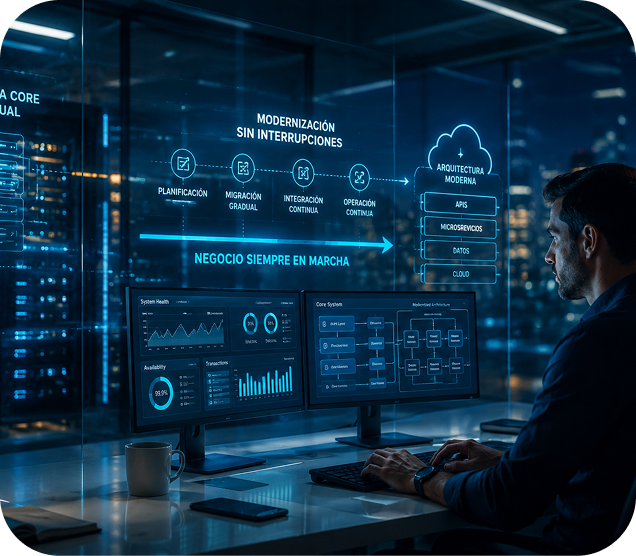


The software that underpins the daily operations of large companies tends to age faster than business strategies. Over the years, legacy systems become cumbersome, expensive to maintain, and resistant to the changes demanded by the market. However, postpone its renewal out of fear of an operational blackout is a financial risk silent.
The real challenge for a technology leader is not deciding whether to modernize their platforms, but how to do it. do it while the business continues to generate revenue every second. The key to resolving this dilemma lies in changing the way we approach infrastructure projects.
Layered progressive migration strategy
The idea of shutting down an old system on Friday night to turn on a new one on Monday morning is a thing of the past. Current upgrade processes are designed using... creation of intermediate layers and microservices that coexist with the original platform.
This approach allows for the gradual migration of business functions, prioritizing critical modules. The main ones advantages The characteristics of this model are:
• Impact isolation: If any unforeseen event occurs during the transition, it is contained in a specific module without affecting the end customer's experience.
• Transactional continuity: Payment systems, billing gateways, and user-facing workflows never stop receiving data.
• Constant validation: Each stage is tested with real users before taking the next technical step.
Automation as a shield against operational risk
Mitigating IT risk requires replacing manual processes with automated validation workflows. The integration of intelligent tools allows replicating the behavior of the old system and comparing it in real time with the new one, ensuring the data consistency.
By reducing human intervention in stress testing and database migration, the probability of critical errors drops dramatically. In this way, technological upgrades cease to be a threat to business continuity and become an asset. predictable process.
Technical agility to protect cash flow
Plan the evolution of your digital infrastructure A phased approach ensures that your technology investment delivers returns from the earliest stages. You don't need to wait for a two-year project to finish to see improvements in your platform's speed and efficiency.
Ultimately, securely upgrading your organization's core technology protects the most valuable asset of any business: the trust from your customers and the stability of your income.
At Zenta, we understand the value of business continuity, which is why we support companies on their journey to the cloud using advanced methodologies such as NextGen Migration, designed to modernize your core systems with a operational risk reduced to zero.
Are you ready to upgrade your infrastructure without putting your sales on hold?